

swords · Minor Arcana
Five of Swords
“I choose my battles wisely and release what no longer serves my peace.”
Five of Swords upright means hollow victory, conflict fallout, walking away; reversed, it means seeking reconciliation, releasing resentment, learning from conflict.
Upright
- hollow victory
- conflict fallout
- walking away
- self-interest
One figure gathers up the swords while others walk away defeated, and the expression on the winner's face is telling: this triumph doesn't feel as satisfying as it should. The Five of Swords speaks to conflicts where technically winning costs something real, a relationship, trust, or your own peace of mind. It asks an honest question: is this fight actually worth what it's taking from you? Not every disagreement needs to be won. Sometimes the more powerful move is choosing which battles deserve your energy at all, and walking away from the rest with your integrity intact.
Reversed
- seeking reconciliation
- releasing resentment
- learning from conflict
- de-escalation
The dust is settling, and there's an opening now to repair what conflict damaged. Reversed, the Five of Swords often points toward reconciliation, an apology extended or accepted, or simply the decision to let go of needing to be right. It can also mean recognizing a pattern where you win the argument but lose the connection, and choosing differently next time. Release the resentment you're still carrying from an old fight. It's taking up space that could be used for something more nourishing.
Themes in depth
How Five of Swords speaks to different areas of life.
Love
Upright
A disagreement may leave one person feeling like they won and the other feeling diminished. Notice if being right matters more to you right now than being close. Sometimes softening does more for the relationship than victory would.
Reversed
There's real potential for repair here, an honest conversation that mends what conflict tore. Letting go of old resentment, rather than replaying who said what, opens the door to genuine reconciliation and renewed trust.
Career
Upright
A workplace conflict may technically resolve in your favor while leaving relationships strained. Consider the cost of winning this particular battle. Sometimes the wiser professional move is choosing collaboration over being proven right.
Reversed
You have a chance to smooth over recent friction with a colleague or repair a professional relationship that soured. Approaching the conversation without needing to relitigate who was at fault will get you further than pride would.
Wellness
Upright
Notice if you're carrying tension from a recent conflict in your body, a tight jaw, a clenched stomach. Ask whether replaying the argument mentally is actually serving you, or simply keeping the stress alive longer than necessary.
Reversed
This is a good moment to consciously release grudges you've been holding, even quietly. Forgiveness, especially the kind you extend for your own sake, tends to lighten the body as much as the mind.
Yes or No?
Leans noLeans no. The card points to a win that costs more than it's worth. It turns to yes only if you'd be content with the outcome even if the other side gets nothing, which is rare.
Reading It in Real Situations
When It's Unclear Between You
Upright
A teasing exchange turns into a point-scoring contest, or one of you always needs the last word. Notice who is keeping score. Winning the argument and getting closer are different goals, and you only get one.
Reversed
You're pulling back from a fight you don't need to win, or a small apology is possible. Name the one thing you got wrong and leave the rest. If you only want closeness when you've been proven right, say so to yourself.
Getting Back With an Ex
Upright
The breakup may have ended in a victory for someone, and that is hard to build on. Hold off on rehearsing the debate. If the relationship included put-downs, threats or control, speak to a trusted person or a support line.
Reversed
Resentment is easing and the old argument seems less important. This is a reason to talk, not a guarantee. If you reach out, don't reopen who was right. Ask how they have been, and see how the reply reads.
Job Hunting
Upright
A workplace where credit is stolen, or you might be the one winning meetings at someone's expense. Choose interviews and teams where cooperation shows. In an interview, don't criticize your past employer, even if deserved.
Reversed
A hostile exchange has ended, or you backed down and it stung. Winning a negotiation with a poor temperament may still close a door. Rehearse a calm sentence for the unfair comment, then say it.
Money Worries
Upright
You win the haggle, but the relationship pays for it. Watch the habit of splitting every bill to the cent or hiding purchases from a partner. A small loss on a shared expense can be cheaper than the argument.
Reversed
Disputes over money with family or a roommate have cooled. Settle shared costs in writing so nobody has to prove who owes what. If a pressured payment leaves you afraid, tell someone you trust.
What to Look For in the Card
Based on the classic 1909 imagery. Details differ in other deck styles.
A smirking figure in the foreground holds two swords and has just picked up a third, while two other swords lie on the ground. Two figures walk away toward the water with their heads low, under a sky of torn clouds. The weapons are no longer in their hands, so the fight is over, but the winner's expression is not warm. The picture asks what he actually gained. It reads as a victory that left the relationship worse off.
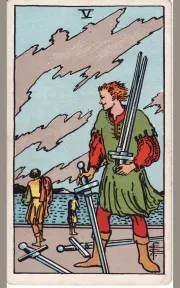
Classic 1909

Style Ⅰ

Style Ⅱ
How It Gets Misread
This card is often read as simply winning, or as someone else being the villain. The sharper reading is that how you win can cost more than the issue was worth. It is also not always about the other person: it can be you walking away after losing, with nothing left to prove. Ask who is still around once the argument is settled.
One Small Thing to Do
Before your next disagreement, decide what outcome you actually want, whether it is a fix, an apology or simply being heard. If you notice you only want to be right, say one sentence that gives the other person something back.
A Question to Sit With
If I win this point, what will I have lost with the person involved?
When It Appears With
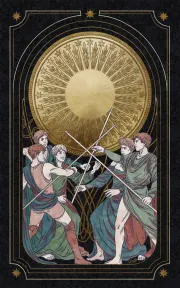 Five of Wands
With the Five of Wands, the dispute is loud and scattered; sort out what you are fighting for before more people join in.
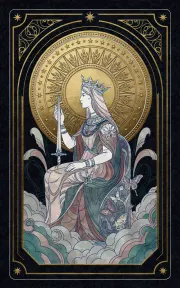 Queen of Swords
With the Queen of Swords, bluntness can end the contest cleanly, provided it stays honest and does not turn into scoring points.
More from the Suit of swords
Same Number, Other Suits
Bring This Card to a Real Question
A card means more once it is sitting in your own question.
Learn to Read It
Want to see this card in a reading?
Draw Your Card