
wands · Minor Arcana
Five of Wands
“I let honest friction sharpen me instead of shrinking me.”
Five of Wands upright means creative friction, competition, clashing ideas; reversed, it means avoided conflict, internal tension, settling disputes.
Upright
- creative friction
- competition
- clashing ideas
- productive tension
- sharpening skill
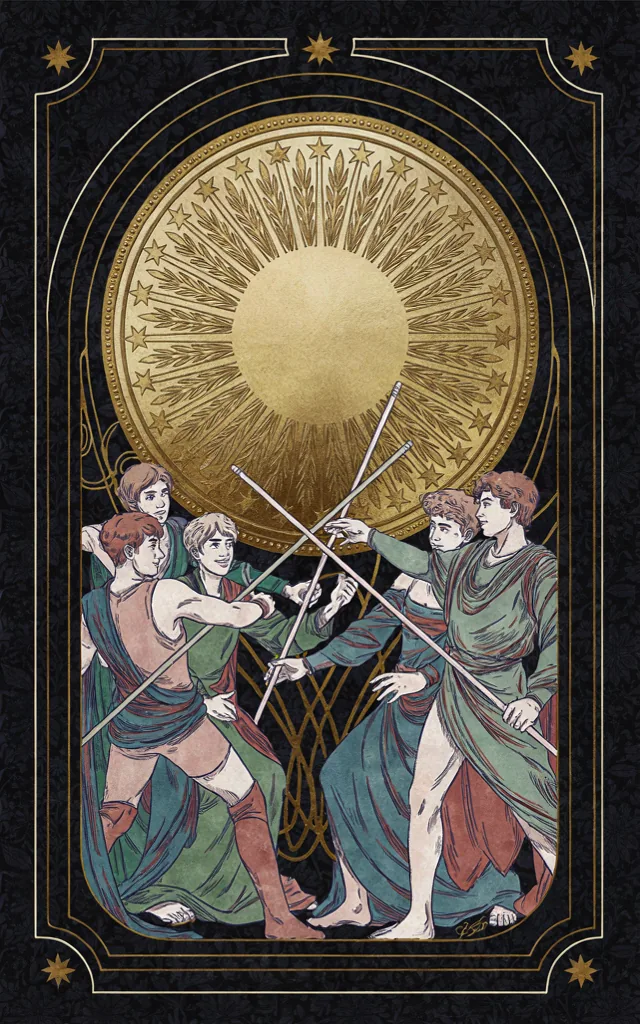
Five figures wield their wands in what looks like chaos but is closer to a sparring match — everyone testing their strength against the others, no one truly trying to cause harm. This card reflects the friction that happens when multiple strong energies, opinions, or ambitions occupy the same space. Rather than a warning of danger, the Five of Wands can be read as an invitation to engage with disagreement as a sharpening tool. Competing ideas, when voiced honestly, often produce something stronger than any one of them alone. The discomfort here is often just the sound of growth colliding with itself.
Reversed
- avoided conflict
- internal tension
- settling disputes
- misaligned team
The clash may be moving underground — tension that's avoided rather than addressed, or a conflict resolved on the surface while resentment lingers beneath. Reversed, this card can also mean you're the one holding back from healthy debate, staying quiet to keep the peace at your own expense. Consider where a direct conversation, even an uncomfortable one, would actually clear the air faster than continued avoidance. Some friction needs air and light, not suppression.
Themes in depth
How Five of Wands speaks to different areas of life.
Love
Upright
Some tension or disagreement may be surfacing, and it isn't necessarily a bad sign — it can mean both people are showing up honestly. Use this friction to understand each other's needs rather than to declare a winner. Healthy conflict builds intimacy over time.
Reversed
Disagreements may be getting swallowed instead of spoken, building quiet distance. Or old arguments keep resurfacing without resolution. Try naming the real issue directly rather than circling it indefinitely.
Career
Upright
Competing ideas or personalities at work are creating friction, but this can sharpen the final outcome if everyone stays engaged rather than defensive. Healthy debate now can prevent bigger problems later. Don't mistake disagreement for dysfunction.
Reversed
Conflict may be simmering unspoken, affecting morale without anyone naming it directly. Alternatively, you might be avoiding a necessary confrontation about roles or credit. Address it plainly before it calcifies into resentment.
Wellness
Upright
Inner conflict — competing priorities, values, or desires — is asking to be worked through rather than suppressed. This tension can actually clarify what matters most to you. Let the parts of you in disagreement actually talk to each other.
Reversed
You may be avoiding an internal reckoning, staying busy to outrun a feeling you haven't fully faced. Reversed, this card asks for honest self-dialogue rather than more distraction. Naming the discomfort is often the fastest way through it.
Yes or No?
DependsMaybe. The Five of Wands shows contested ground, so the answer depends on competition and who else is involved. If you are willing to argue your case and adjust, the odds improve. If you want it easy, they do not.
Reading It in Real Situations
When It's Unclear Between You
Upright
Banter, teasing, a bit of rivalry: the connection has friction, and that can be fun. Check whether the sparring ends warmly or leaves one of you smaller. If you are competing for attention, consider simply saying what you want.
Reversed
You may be avoiding a real talk, and the tension runs under the surface: sharp jokes, silences after small remarks, or you both pretending nothing is wrong. Say one honest sentence about it. Being cold or controlling is a reason to step back, not push.
Getting Back With an Ex
Upright
Old arguments may resurface when you talk. The test is whether you can disagree without winning. If every exchange turns into replaying who was right, pause. Contact that is loud and unproductive rarely repairs anything.
Reversed
The anger has gone quiet but is not gone. You may be replaying the old fights, or telling the story to friends again and again. Put the argument on paper for yourself, then see what you wish had been said. If the relationship involved control or fear, talk to someone you trust.
Job Hunting
Upright
Several candidates, a crowded process, an interview with a panel or a sharp question. Prepare two or three stories that show how you handle disagreement. Competition here sharpens you, so treat each round as practice for the next.
Reversed
You may be tense with colleagues, or you spend more energy dodging conflict than doing the work. Before applying elsewhere, decide what you really want to change: the people, the tasks, or the setting. Bring a specific example to interviews, not a complaint.
Money Worries
Upright
Money friction shows up in shared costs, a split bill, or a pricing debate. Settle the split in advance and write it down. Asking for a fair rate is part of the card, so state your number first and avoid underbidding to win the job.
Reversed
Money tension is kept inside: you resent a cost but never mention it, or you quietly overspend to avoid an argument. Name one concern to the person involved. Settling small disputes early is usually cheaper than letting them stand.
What to Look For in the Card
Based on the classic 1909 imagery. Details differ in other deck styles.
Five young men swing their staves at each other on open ground. Nobody carries a weapon beyond a stick, nobody is shown wounded, and the clothes are colourful and mismatched. That detail matters: it looks more like a chaotic scrimmage than a war. No one is winning, and no one is obviously in charge. The card reads as friction between equals who each think they are right, which is noisy but rarely fatal.
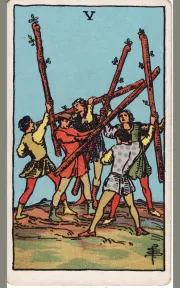
Classic 1909
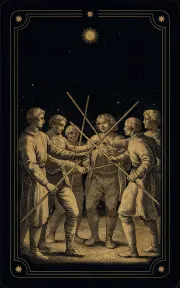
Style Ⅰ
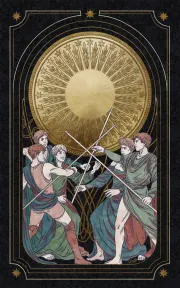
Style Ⅱ
How It Gets Misread
The Five of Wands is often read as a serious fight or a hostile enemy. The picture is closer to a messy, competitive scramble where everyone is pushing their own approach. The accurate reading is conflict that can still be useful: competition, clashing ideas, a crowded team. It becomes a problem only when no one stops to set the rules.
One Small Thing to Do
Next time you are in a tangled discussion, stop and write down in one sentence what each side actually wants. Then propose one shared rule, such as who decides or by when, and see whether the noise drops.
A Question to Sit With
Am I arguing for the outcome I want, or only for my own way of getting there?
When It Appears With
 Justice
With Justice, the scramble needs a fair rule; settle it by criteria everyone can see, not by who pushes the hardest.
 Five of Swords
With the Five of Swords, the friction turns sharper: be careful that winning the argument does not cost you the relationship.
More from the Suit of wands
Same Number, Other Suits
Bring This Card to a Real Question
A card means more once it is sitting in your own question.
Learn to Read It
Want to see this card in a reading?
Draw Your Card