
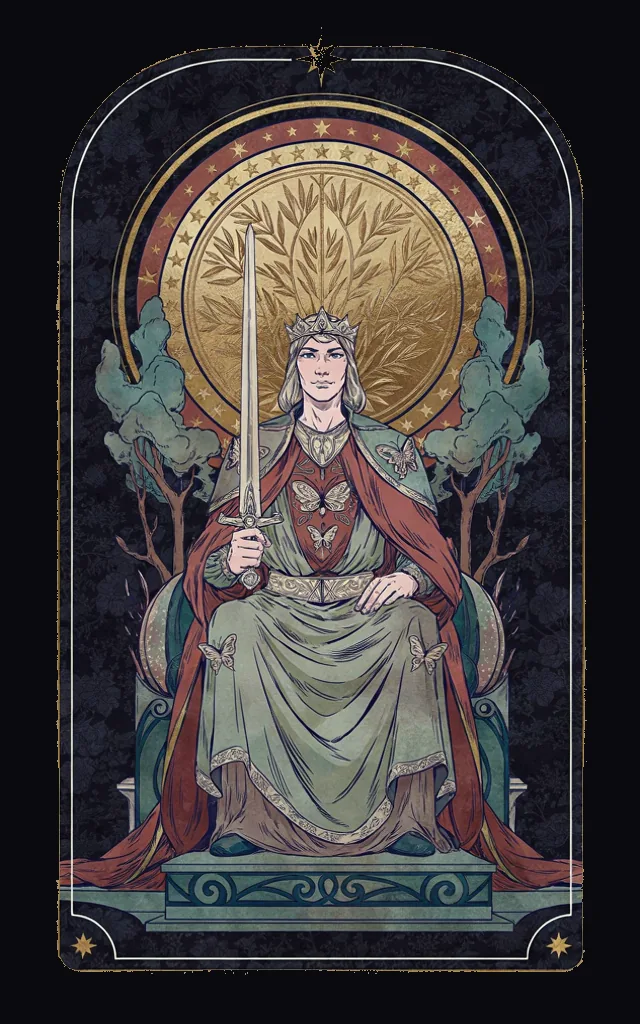
swords · Minor Arcana
King of Swords
“I think clearly, act fairly, and lead my life with honest, steady wisdom.”
King of Swords upright means strategic mastery, fair judgment, clear authority; reversed, it means cold detachment, rigid thinking, abuse of logic.
Upright
- strategic mastery
- fair judgment
- clear authority
- principled decisions
Seated with his sword held perfectly upright, the King of Swords rules through clarity of thought rather than force. He represents intellectual mastery matured into wisdom: the ability to weigh a complicated situation fairly, set emotion aside long enough to see the facts, and make a principled decision others can trust. This card often signals a moment to lead with your mind, to make the hard call, structure the plan, or deliver a fair verdict others have been avoiding. His authority isn't cold; it's earned through consistent, honest thinking applied over time. Trust the clarity you've built.
Reversed
- cold detachment
- rigid thinking
- abuse of logic
- manipulative reasoning
The sharp mind has turned rigid or detached, using logic to dominate rather than to clarify. Reversed, the King of Swords can describe someone relying on cold reasoning to avoid genuine feeling, or twisting facts to win an argument rather than find the truth. It may also point to being overly critical or inflexible in your own thinking, unwilling to consider a perspective that doesn't fit your existing framework. The invitation is to reconnect intellect with empathy. Strategic thinking is most powerful when it stays honest and stays humane.
Themes in depth
How King of Swords speaks to different areas of life.
Love
Upright
A relationship may benefit from clear, honest, adult conversation right now, the kind where both people say what they actually mean. Your steady, fair-minded approach helps build the kind of trust that lasts.
Reversed
Emotional distance or overly rigid expectations may be creating friction. Notice if you're approaching the relationship like a problem to solve rather than a connection to feel. A little more warmth would serve you both well.
Career
Upright
This is a strong time to lead, negotiate, or make a decision that requires impartial, strategic thinking. Others will likely respect a clear, well-reasoned call, even a difficult one, more than they'd respect further delay.
Reversed
Rigid thinking or an overly critical approach may be alienating colleagues. Consider whether you're applying logic fairly or using it to justify a decision you'd already made. Flexibility now will serve you better than control.
Wellness
Upright
A structured, disciplined approach to your wellbeing, a clear plan, consistent habits, honest self-assessment, is likely to serve you well. Trust your own steady judgment about what you actually need right now.
Reversed
You may be over-relying on logic to manage feelings that actually need to be felt rather than analyzed. Give yourself permission to be less in control for a moment, and let emotion inform your thinking too.
Yes or No?
DependsMaybe, and the answer rests on facts and terms, not hopes. Ask what the rules are, who decides and what the evidence shows. A fair judgment is possible only if you put the real facts on the table.
Reading It in Real Situations
When It's Unclear Between You
Upright
The other person may be measured and slow to show feeling. Don't mistake reserve for indifference or for interest. Look at consistent action over time: do they keep appointments, do what they say? Ask directly what they want.
Reversed
Cold logic is being used in place of warmth, or someone argues you out of your own feelings. If you hear that you're too emotional every time you raise a need, that's worth naming. Healthy reasoning makes room for you.
Getting Back With an Ex
Upright
You can assess the relationship fairly and decide without drama. Make a list of what worked and what didn't, then check whether anything has changed. If the relationship involved control, belittling or intimidation, seek advice from a trusted person or a support service.
Reversed
Control, point-winning or cutting remarks keep the pattern of the past in place. Reasoning can be used to manipulate, and clever arguments don't equal right. If you recognize being talked out of your own memory, talk to someone outside it.
Job Hunting
Upright
Strong for interviews and negotiation: prepare numbers, know your range, state it plainly. Ask about structure, decision-makers and review. Put agreed terms in writing. A manager's fairness shows in how they speak of absent people.
Reversed
A boss or process may be rigid, or you are. Cold authority can use rules unfairly. Document what's asked of you, keep copies. If conduct crosses into harassment or retaliation, seek advice from HR, a union or a legal clinic.
Money Worries
Upright
Good time to set rules: a budget with limits, a review date, a written plan. Decide with facts, not mood. Keep the system simple enough that you'll actually follow it. This is general structure, not a financial recommendation.
Reversed
Rigid thinking about money, or someone using numbers to control you, such as restricting access to funds. Financial control is a recognised form of abuse. If it applies, speak to a trusted person or a support service.
What to Look For in the Card
Based on the classic 1909 imagery. Details differ in other deck styles.
The king sits facing the viewer on a throne carved with butterflies, a sword raised point-up in one hand. He wears a blue robe under a purple-gray cloak lined in orange-red, with clouds drifting behind him. His posture is frontal and still, unlike the Queen's profile, so he reads as someone willing to be seen and held to account. The raised sword, pointed at no one, matches his role: he decides by principle, and he is expected to explain the decision.

Classic 1909

Style Ⅰ

Style Ⅱ
How It Gets Misread
The King of Swords is often read as a cold boss or a judge who cannot be argued with. That is the shadow. At his best he is fair and clear, and he can explain his reasoning. The common error is to trust logic so much that feelings count as irrelevant data. Good judgment includes asking who will be affected and why.
One Small Thing to Do
Choose one decision you have been putting off and write the criteria first, in three bullet points, before comparing options. Share them with one person affected and ask whether any are missing.
A Question to Sit With
Would I stand by this decision if I had to explain it to the person it affects?
When It Appears With
 The Emperor
With the Emperor, authority and structure align, so set clear rules and keep them yourself first.
 Justice
With Justice, the standard is fairness; weigh the facts, not the mood, and accept responsibility for the outcome.
More from the Suit of swords
Same Number, Other Suits
Bring This Card to a Real Question
A card means more once it is sitting in your own question.
Learn to Read It
Want to see this card in a reading?
Draw Your Card