
pentacles · Minor Arcana
Eight of Pentacles
“I show up for my craft with patience, and mastery follows.”
Eight of Pentacles upright means diligent practice, skill-building, focused craftsmanship; reversed, it means perfectionism, uninspired repetition, cutting corners.
Upright
- diligent practice
- skill-building
- focused craftsmanship
- steady improvement
- dedication to mastery
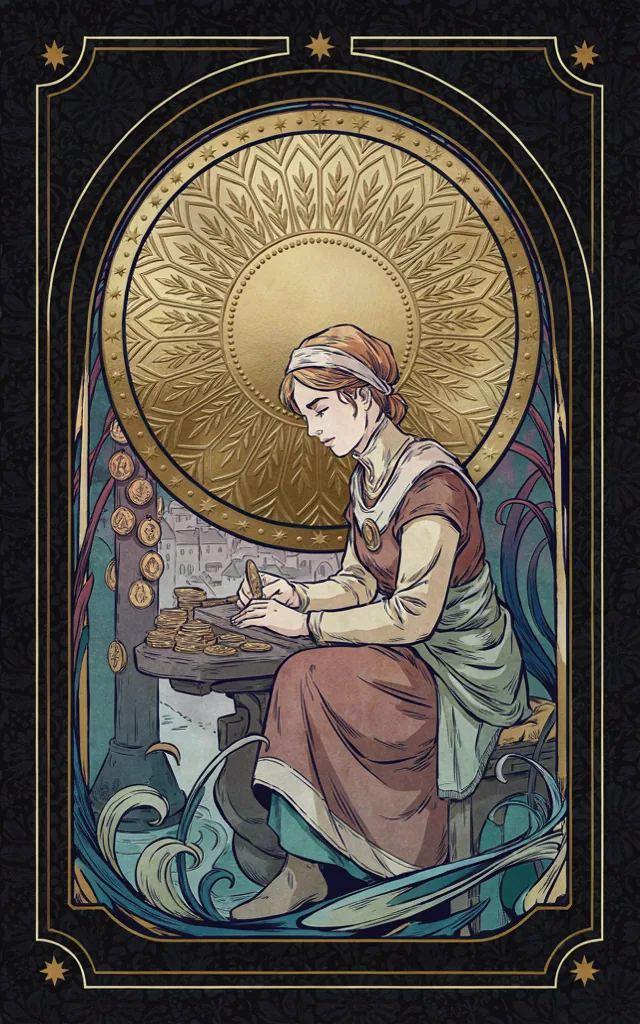
A craftsperson sits absorbed in carving one pentacle after another, the finished ones already lined up as proof of the work. The Eight of Pentacles is the card of deliberate practice — showing up daily to refine a skill, not because it's glamorous but because mastery is built one careful repetition at a time. This is a favorable moment for learning, apprenticeship, or simply putting focused hours into something you care about getting right. The reward here isn't instant; it accumulates quietly with every session of honest effort.
Reversed
- perfectionism
- uninspired repetition
- cutting corners
- lost motivation
The craft has lost its spark, or the standards have slipped. Reversed, the Eight of Pentacles can mean going through the motions without real engagement, cutting corners to finish faster, or chasing an unattainable perfectionism that saps all the joy from the work. It may also point to boredom with a skill that once excited you. Reconnect with why this practice mattered to you in the first place, or consider whether it's time to channel your diligence toward something that reignites your attention.
Themes in depth
How Eight of Pentacles speaks to different areas of life.
Love
Upright
You're putting genuine, consistent effort into understanding a partner or building relationship skills — better communication, patience, follow-through. This steady investment of care is exactly what deepens intimacy over time. Small consistent actions matter more than grand gestures here.
Reversed
Effort in the relationship may feel rote or half-hearted lately, going through familiar motions without real presence. Reconnect intentionally, or consider whether perfectionism about how the relationship "should" look is getting in the way of enjoying it.
Career
Upright
Focused skill-building is paying off — training, practice, or refining your craft with real dedication. This is an excellent period for professional development. Trust that the unglamorous, repetitive work is exactly what's building your expertise.
Reversed
You may be coasting on autopilot, cutting corners, or losing motivation for work that once engaged you fully. Alternatively, perfectionism might be slowing you down unnecessarily. Reassess what would make the effort feel meaningful again.
Wellness
Upright
Consistent, unglamorous daily practice — sleep habits, movement, mindfulness — is quietly building real strength. Trust the discipline even when progress feels slow and invisible; mastery of wellbeing is built the same way any skill is: repetition with care.
Reversed
A wellness routine may have become mechanical, or perfectionist standards are making healthy habits feel punishing rather than nourishing. Reconnect with what originally motivated the practice, or allow yourself a more forgiving, sustainable version of it.
Yes or No?
Leans yesLeans yes when the question is about improving through practice, like finishing a course or mastering a skill. It stays conditional on whether you will keep showing up. It leans no for anything that expects a shortcut.
Reading It in Real Situations
When It's Unclear Between You
Upright
Warmth builds through repeated small acts rather than a big gesture: remembering details, showing up on time, replying even when busy. Look for these in the other person, and give them yourself. It is slow, but you can observe it.
Reversed
Either you are fixing every flaw in how you appear, or the other person gives only minimum effort. Over-polishing messages, rewriting texts for hours, or testing a person with small silences wears you out. Say a plain thing, and see what comes back.
Getting Back With an Ex
Upright
If you want to repair, the work is practical: learn what went wrong, practice listening, change one habit and keep it. Fixing yourself is useful regardless. It does not require the other person to agree, and it does not decide whether they return.
Reversed
You may be stuck in a loop of self-improvement as a way to avoid the grief, or repeating the same arguments by rote. Effort aimed at winning someone back becomes draining. Aim the work at your own days instead, and ask for help if it is heavy.
Job Hunting
Upright
Very good for skills-based jobs. Polish your portfolio, practice common interview questions aloud, and learn the tools listed in the posting. Specific, prepared answers will carry more weight than confidence alone. Steady preparation shows.
Reversed
Perfectionism delays sending applications, or the work has become routine and you feel unmotivated. Set a limit: send the application once it is good enough, and ask someone to review. Cut corners only where they will not show, not on the core pieces.
Money Worries
Upright
Income improves through craft: a skill gets you better pay, more hours, or steady clients. Keep records of what you earned and learned. This is about earning through work, not an instruction on spending or placing money.
Reversed
Extra work does not raise income, or you spend too much time on tasks that pay little. Look at how your hours convert to money and where effort is wasted. Skipping rest to earn more can backfire; check your limits.
What to Look For in the Card
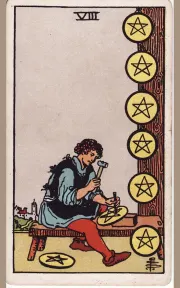
Based on the classic 1909 imagery. Details differ in other deck styles.
A craftsman sits at a bench and carves pentacle after pentacle. Finished ones are mounted on a post beside him, and a small town sits far off on a hill. He is turned away from the town and bent over his work. The row of finished coins shows repetition: each one is practice, and each is a little better than the last. The distance from town signals focus bought with solitude. The reading is about skill built coin by coin, not a flash of talent.
Classic 1909

Style Ⅰ

Style Ⅱ
How It Gets Misread
Treated as hard work always wins, or as pure drudgery. The picture shows a person absorbed in getting better at a craft, where the goal is quality, not volume. It also asks whether the repetition is still teaching you something. Practice that has slid into autopilot is a different situation. Read it as deliberate practice, not endurance for its own sake.
One Small Thing to Do
Block one stretch of focused time, even 40 minutes, on a skill you want to improve. Choose one narrow part of it, repeat it deliberately, and stop when the time is up rather than when you feel finished.
A Question to Sit With
What small part of my craft would improve most if I repeated it on purpose?
When It Appears With
 The Hermit
With the Hermit, the solitude is deliberate and the lamp is lit: learning in quiet, with a guide in mind. Do the work, then come back down to share it.
 Four of Swords
With the Four of Swords, effort is followed by rest. A craftsperson who never stops loses precision, so treat recovery as part of the practice.
More from the Suit of pentacles
Same Number, Other Suits
Bring This Card to a Real Question
A card means more once it is sitting in your own question.
Learn to Read It
Want to see this card in a reading?
Draw Your Card